
You finally launched your WordPress site. The design looks good, the pages are live, your contact form works, and maybe you’re already collecting emails, tracking visitors with analytics, or preparing to run ads.
But there’s one page that a surprising number of WordPress site owners forget.
A privacy policy.
That one missing page can create far bigger problems than most people expect, from regulatory risk and ad account issues to losing visitor trust before you’ve had a chance to earn it.
So, do you need a privacy policy on your website? In most cases, yes. If your site collects, tracks, stores, or shares personal information, you likely need a clearly written privacy policy explaining what data you gather and how you use it.
This guide covers everything WordPress site owners need to know, including website legal requirements in 2026, the real risks of skipping a privacy policy, and the fastest way to get compliant without hiring a lawyer.
What Is a Privacy Policy and Why Does It Matter?
A privacy policy is a legal page that tells your visitors how your website handles their personal information. It explains what you collect, why you collect it, who you share it with, and how long you keep it.
Depending on your site, that information can include names, email addresses, phone numbers, IP addresses, payment details, contact form submissions, cookie data, analytics data, and advertising or retargeting data.
If your WordPress site has a contact form, newsletter signup, analytics script, checkout page, comments section, membership area, or ad pixel, you are almost certainly already collecting some form of personal data.
That is why a WordPress privacy policy is not just a formality. For most websites, it is a basic legal requirement and a direct signal of trustworthiness to every visitor who lands on your site.
Do I Need a Privacy Policy on My Website?
If your website collects personal information in any form, you most likely need a privacy policy. This applies to a much wider range of WordPress sites than most people realise, including:
- Blogs with newsletter or lead capture forms
- Business websites with contact forms
- WooCommerce and eCommerce stores
- Affiliate websites using tracking links or pixels
- Membership and subscription sites
- Portfolio sites with inquiry forms
- Any site using Google Analytics or similar tools
- Sites running advertising or retargeting campaigns
- Sites that allow comments or user accounts
Even a basic contact form collecting nothing more than a name and email address counts as collecting personal data.
Rather than asking “is a privacy policy legally required?”, the more useful question is: does my site collect or process personal information from visitors? If yes, treat a privacy policy as a non-negotiable legal page.
Privacy regulators in most jurisdictions focus on transparency. Users have a right to know what data is collected, why it is collected, who it is shared with, how long it is kept, and what rights they have over it. The UK ICO states that privacy information should be concise, transparent, easily accessible, and provided at the point of data collection.
What Happens If You Don’t Have a Privacy Policy?
This is what most WordPress site owners actually want to understand. Here is what is genuinely at risk.
1. You May Be Violating Privacy Laws
WordPress site privacy policy law is not limited to large corporations. Several major privacy regulations require websites to be transparent about data collection and use, and they apply to small websites too.
Depending on your audience and location, your site may fall under GDPR, which applies to any website processing personal data of people in the EU regardless of where your business is based. It may also fall under CCPA or CPRA, which covers certain businesses collecting personal information from California residents, or one of the growing number of US state-level privacy laws now active across the country.
Not having a privacy policy, or having one that does not accurately reflect your data practices, can put you in breach of these regulations.
2. You Could Face Penalties or Complaints
Many people search “website without privacy policy penalty” because they want to know how real the risk is.
The honest answer is that it depends on the law, the severity of the issue, and your jurisdiction. But the numbers attached to serious infringements are not small. Under GDPR, serious violations can result in fines of up to 20 million euros or 4 percent of global annual turnover, whichever is higher. A GDPR fine for a small business is a genuine possibility, not just a threat aimed at large enterprises. Small businesses are not automatically exempt from GDPR obligations.
CCPA requirements for websites covered by that law include providing a clear notice at or before the point of data collection and linking to a full privacy policy. Failing to meet those requirements can lead to complaints and enforcement action.
3. Your Ad and Monetisation Accounts May Be at Risk
This is a consequence many site owners do not see coming until it is too late.
Google’s Publisher Policies require that publishers maintain a privacy policy clearly disclosing data collection, sharing, and usage related to Google products, including cookies, pixels, and identifiers. Missing or non-compliant privacy pages can affect your ability to run AdSense and Google Ads. The same applies to many affiliate networks, Facebook Ads, and other advertising and monetisation platforms.
If you plan to earn money from your WordPress site, legal pages are part of the foundation, not an optional extra.
4. Visitors Lose Trust Immediately
When someone cannot find a privacy policy on your site, the questions they ask are: What happens to my email address? Is this site selling my data? Are cookies tracking me? Is this business legitimate?
A clear, accessible WordPress privacy policy removes that doubt and signals that your site is professional and trustworthy. The absence of one often signals the opposite.
5. Third-Party Programmes May Reject Your Site
Affiliate networks, payment processors, ad networks, and SaaS integrations often review your site during the approval process. Missing legal pages is one of the most common reasons applications are declined or accounts flagged before you even get started.
Website Legal Requirements in 2026: What Pages Do You Actually Need?
Website legal requirements in 2026 depend on your location, audience, business model, and data practices. That said, most WordPress websites should have the following core legal pages in place.
Privacy Policy covers what data you collect, why you collect it, how you use it, who you share it with, how long you keep it, and how users can contact you with privacy questions. It should be easy to find, typically in your footer, and also linked near contact forms, checkout pages, and newsletter signups.
Terms and Conditions set the rules for using your website. They cover acceptable use, intellectual property, user responsibilities, payment terms, limitations of liability, and dispute resolution. Not every website is legally required to have one, but it protects your business and sets clear expectations.
Cookie Policy or Cookie Notice is required if your site uses cookies for analytics, advertising, logins, or personalisation. Many privacy laws require clear disclosure or explicit consent before cookies are set.
Disclaimer is important for any site publishing advice, reviews, affiliate content, health content, or financial content. An affiliate disclaimer, for example, should make clear that you may earn a commission from products you recommend.
Refund or Return Policy is necessary if you sell products, services, downloads, or subscriptions. It clarifies what customers can expect and helps prevent disputes.
Common WordPress Features That Collect Personal Data
Many site owners are surprised by how much data their site is already collecting. Here is a quick reference:
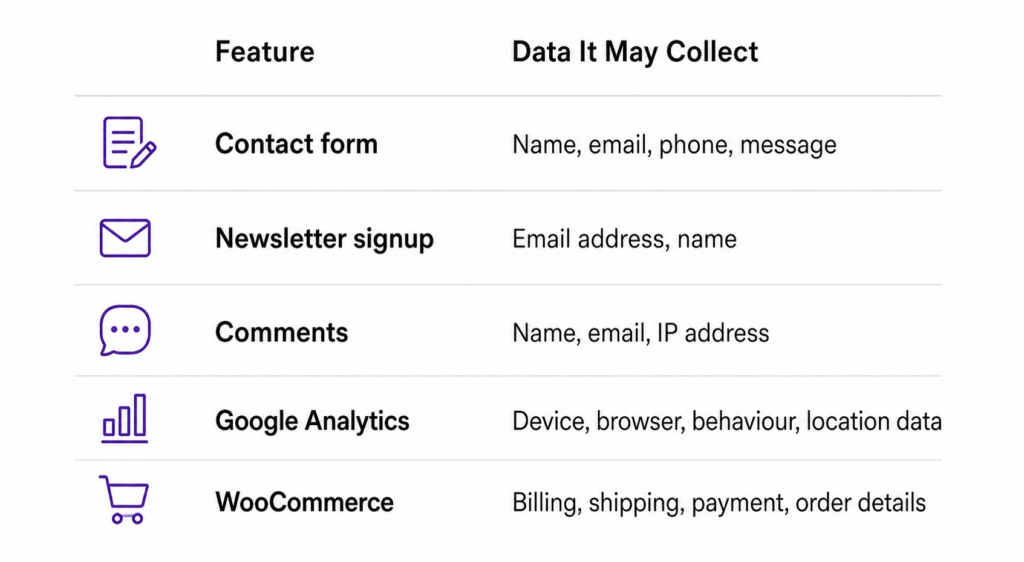
If your site uses any of these, a WordPress privacy policy should already be in place.
What Should a WordPress Privacy Policy Include?
Your privacy policy should reflect your actual website, not a generic template copied from somewhere else. A policy that lists tools you do not use, or ignores the ones you do, serves neither you nor your visitors.
At a minimum, a solid WordPress privacy policy should cover who you are and how to contact you, what personal data you collect and why, how you use cookies and tracking tools, which third-party services process user data on your behalf, what rights users have over their data, and how long you keep personal information.
Common third-party services to mention include Google Analytics, Google AdSense, Mailchimp, Stripe, PayPal, Facebook Pixel, and any CRM, security, or booking plugins that handle user data.
The Easiest Way to Add Legal Pages to WordPress
Creating legal pages manually is time-consuming, especially if you are not familiar with what privacy laws actually require. This is where a dedicated plugin makes a real difference.
Legal Pages is a WordPress plugin that lets site owners generate essential legal pages directly from their WordPress dashboard. Instead of searching for templates, copying text from other websites, and trying to format everything manually, you can create a Privacy Policy, Terms and Conditions, Cookie Policy, GDPR-related pages, CCPA-related pages, Disclaimer, DMCA Policy, and Refund Policy in a fraction of the time.
Here is how to get started:
Step 1: In your WordPress dashboard, go to Plugins, click Add New, search for Legal Pages, install, and activate.
Step 2: Open the Legal Pages menu from your dashboard and select the page you need. Start with your Privacy Policy.
Step 3: Enter your website and business details so the generated page accurately reflects your site.
Step 4: Review, edit if needed, and publish the page.
Step 5: Add a link to your footer and near any forms, checkout pages, or newsletter signups so it is easy to find.
Pre-Launch Legal Page Checklist for WordPress Sites
Before you publish your site or run any ads, go through this list:
- [ ] Does your site collect names, emails, phone numbers, or messages?
- [ ] Do you use Google Analytics or a similar tool?
- [ ] Do you use cookies for any purpose?
- [ ] Do you run ads or retargeting pixels?
- [ ] Do you sell products or take payments?
- [ ] Do you allow user accounts or comments?
- [ ] Do you send newsletters or marketing emails?
- [ ] Is your privacy policy linked in your footer?
- [ ] Is it written in plain, clear language?
- [ ] Does it include your contact information?
If you answered yes to any of the data collection questions, your site needs a privacy policy and likely several other legal pages too.
Frequently Asked Questions
Do I need a privacy policy if my website is just a blog?
- Almost certainly yes, if your blog collects personal information in any form. That can happen through comments, newsletter signups, Google Analytics, affiliate links, cookies, or a contact form.
Is a privacy policy legally required?
- It may be, depending on whether your site collects personal data and which privacy laws apply to you. GDPR, CCPA, and a growing number of regional regulations all treat transparency around data collection as a legal obligation.
What happens if you don’t have a privacy policy?
- You risk legal complaints, ad account issues, affiliate programme rejections, and reduced visitor trust. The severity depends on your location, audience, data practices, and the specific laws that apply to your site.
Can I just copy someone else’s privacy policy?
- No. Another site’s privacy policy reflects their data practices, tools, and legal obligations, which are almost certainly different from yours. Using it could give visitors inaccurate information and offer you very little legal protection.
Where should I place my WordPress privacy policy?
- Your footer is the most common placement. You should also link to it near contact forms, checkout pages, newsletter forms, and account registration pages.
Don’t Wait Until There Is a Problem
A privacy policy is one of the easiest legal requirements to overlook and one of the most important to fix before something goes wrong.
If your WordPress website collects visitor information, uses cookies, runs analytics, displays ads, accepts payments, or captures leads, privacy compliance needs to be part of your site’s setup from day one, not something you get around to later.
With Legal Pages, you can create the essential legal pages your WordPress site needs in minutes, without hiring a lawyer or starting from a blank document.
[Install Legal Pages and generate your privacy policy today]